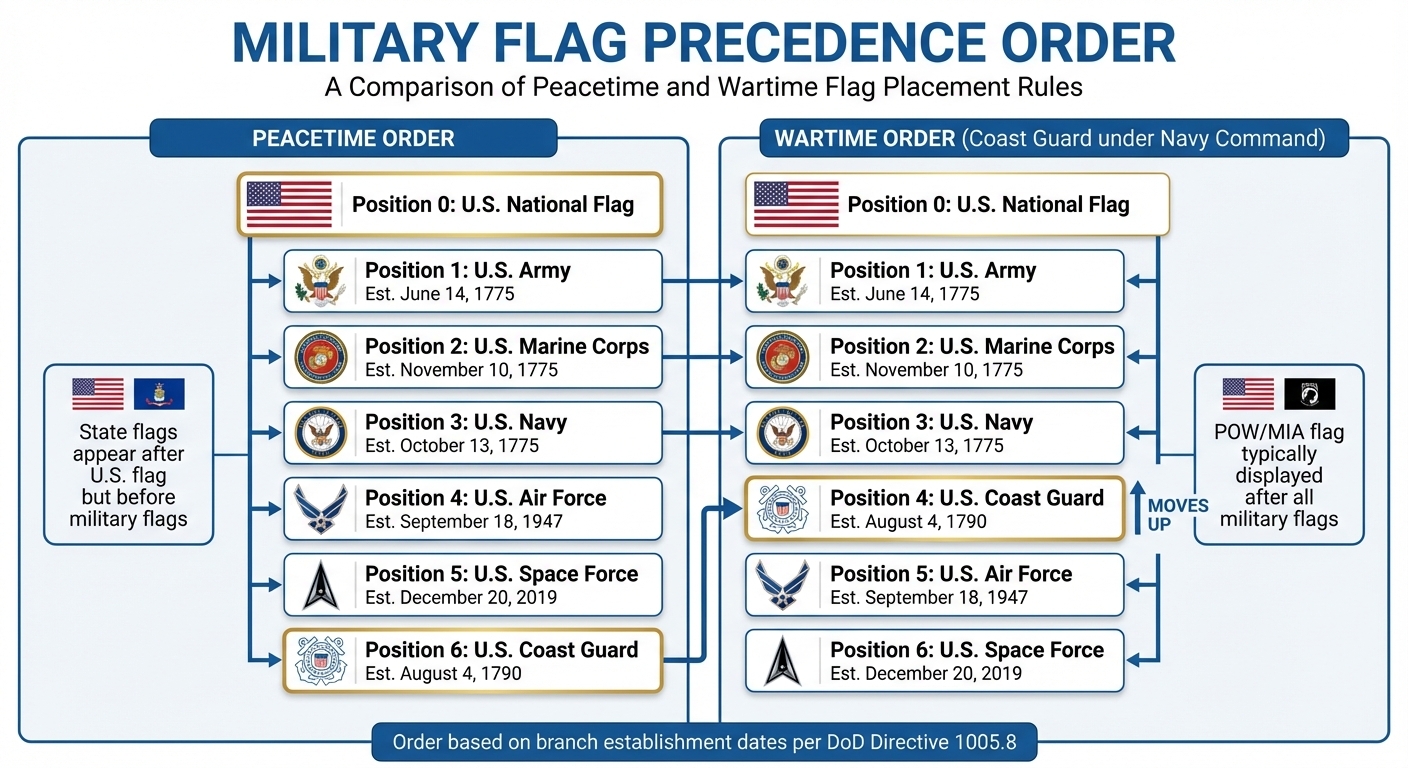
Displaying the Flags of the Armed Services
What is the proper order to display the flags of the United States Armed Services ?
Just as the U.S. military forces conduct themselves in an orderly fashion, so too does a military flag display follow a strict set of rules and order. When flags from each military branch are carried in a horizontal line formation during a parade or flown from a five-flagpole display, the flags must be flown in a certain order. The proper military flag order was prescribed on October 31, 1977, by the U.S. Department of Defense Directive 1005.8.
It states that from left to right, the prescribed peacetime military branch flag order is: Army, Marine Corps, Navy, Air Force and Coast Guard
The Directives prescribed flag-flying order mirrors the order in which each military branch was created, with the lone exception of the Coast Guard. While the Coast Guard is technically the fourth oldest military service branch, with its origins pre-dating that of the Air Force by 157 years, the Coast Guard is excluded from this date-of-origin or birthday rule.
This exception is due to the fact that during peacetime, the Coast Guard falls under the auspices of the U.S. Department of Homeland Security rather than the Department of Defense. During times of war, the Coast Guard typically shifts its reporting structure from the Department of Homeland Security to the Department of Defense. When this transition occurs, so does the prescribed placement order of the Coast Guard flag. During wartime, the Coast Guard flag must be moved from the farthest right position to second from the right, between the Navy flag and the Air Force flag.